
Managing Dispensary Overhead: The Benefits of Purchasing Exit Bags Wholesale
Dispensary overhead adds up in ways that are easy to miss when you focus on inventory, staffing, and compliance. Exit bags are a line item that most operators don't examine closely enough. They order whatever is available, reorder when stock runs low, and accept the per-unit cost as fixed. However, for dispensaries that move meaningful transaction volume, sourcing exit bags wholesale has a real impact on monthly operating costs.
Purchasing exit bags wholesale changes the math. Volume pricing reduces the per-unit cost significantly. Furthermore, consolidating to a single trusted supplier reduces the time your staff spends reordering and chasing lead times. For multi-location operations, standardizing on one wholesale source also simplifies inventory management across sites. These aren't small efficiencies when you multiply them across a full year of operations.
Why Exit Bag Costs Add Up
Exit bags are a consumable. Every transaction that requires one depletes your stock. For a dispensary doing 100 transactions a day, that is 3,000 bags a month at a minimum. At 200 transactions a day, it is 6,000 bags or more. The difference between buying exit bags wholesale versus retail adds up fast.
Beyond unit cost, there is a labor cost to consider. Small reorders, inconsistent lead times, and bag shortages during peak hours all cost real staff time. A wholesale account with a reliable supplier removes most of that friction.
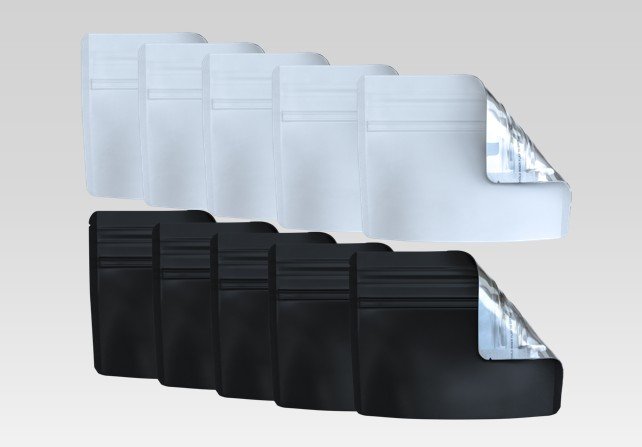
Also, stock-outs are a risk worth taking seriously. Running out of exit bags mid-shift means staff improvising with whatever is available. That creates a compliance risk in states with strict exit bag requirements. It also creates a poor customer experience at the last point of contact in the transaction.
What to Look for in a Wholesale Exit Bag Supplier
Choosing a wholesale exit bag supplier is an operational decision, not just a purchasing one. The wrong partner creates compliance exposure, cash flow friction, and stock-out risk. These four criteria separate the suppliers worth working with from the ones that create problems later.
First, confirm compliance. Exit bags in most regulated states must be opaque and child-resistant. The CR standard for exit bags is typically the same 16 CFR 1700 framework that applies to other cannabis packaging. A supplier who can't confirm that their bags meet this standard is a liability, not a cost savings.
Second, look at minimum order quantities (MOQ). Some wholesale programs require large minimum orders that tie up cash in inventory. A supplier with flexible MOQ options allows you to stock appropriately without over-ordering. For dispensaries still calibrating volume, that flexibility matters.
Third, evaluate lead times and consistency. A supplier that delivers reliably on a consistent timeline allows you to plan inventory. A supplier with variable lead times creates the same stock-out risk. Ask about lead time guarantees and what the process looks like when a delivery runs late.
Fourth, consider whether the supplier can also support branded exit bags when you're ready to upgrade from stock. Some dispensaries start with plain stock bags and move to custom-printed versions as volume justifies the investment. A supplier who can handle both saves you from managing multiple vendor relationships.
Among the four, compliance is the one non-negotiable. The other three criteria are about fit and operational reliability. A supplier who passes all four criteria is definitely a partner rather than just a vendor.
Stock vs. Custom Exit Bags: The Cost Comparison
Stock exit bags are the lower upfront cost option. They ship quickly and need no design work or plate setup. For dispensaries in early stages or those managing tight cash flow, stock bags are the practical starting point.

Custom exit bags carry a higher per-unit cost on small runs, but that calculus changes at volume. At 5,000 or more units per quarter, some suppliers price custom printed bags at or below stock bag rates. Once you add the labor cost of applying sticker labels, the comparison shifts further. For high-volume dispensaries currently using stock bags with sticker labels, it is worth running that comparison.
In addition, custom bags eliminate the label application step from your process. Custom bags also save real labor time on every transaction. Over a full quarter at high volume, it adds up to a meaningful labor cost reduction.
Managing Exit Bag Inventory
For dispensaries buying exit bags wholesale, inventory management is straightforward but worth getting right. Keep enough stock on hand to cover at least two to three weeks of transactions at your peak volume. Build reorder triggers into your point-of-sale or inventory system so you never run short. Coordinate bag restocks with your regular supplier schedule to consolidate deliveries where possible.
For multi-location operations, centralizing exit bag purchasing through one account gives you better pricing leverage and simplifies tracking. Similarly, it reduces the time your team spends managing multiple suppliers. A single invoice and a single supplier relationship are easier to manage. In short, one account beats four accounts ordering on their own.
Sourcing exit bags wholesale is one of the clearest ways to cut overhead without affecting the customer experience. If you're ready to explore your options, request a free quote and we'll help you find the right volume and format for your operation.